Notion AI Onboarding: From User Journey Insights to Testable Hypotheses
Breaking down the user onboarding funnel to surface insights and actions.
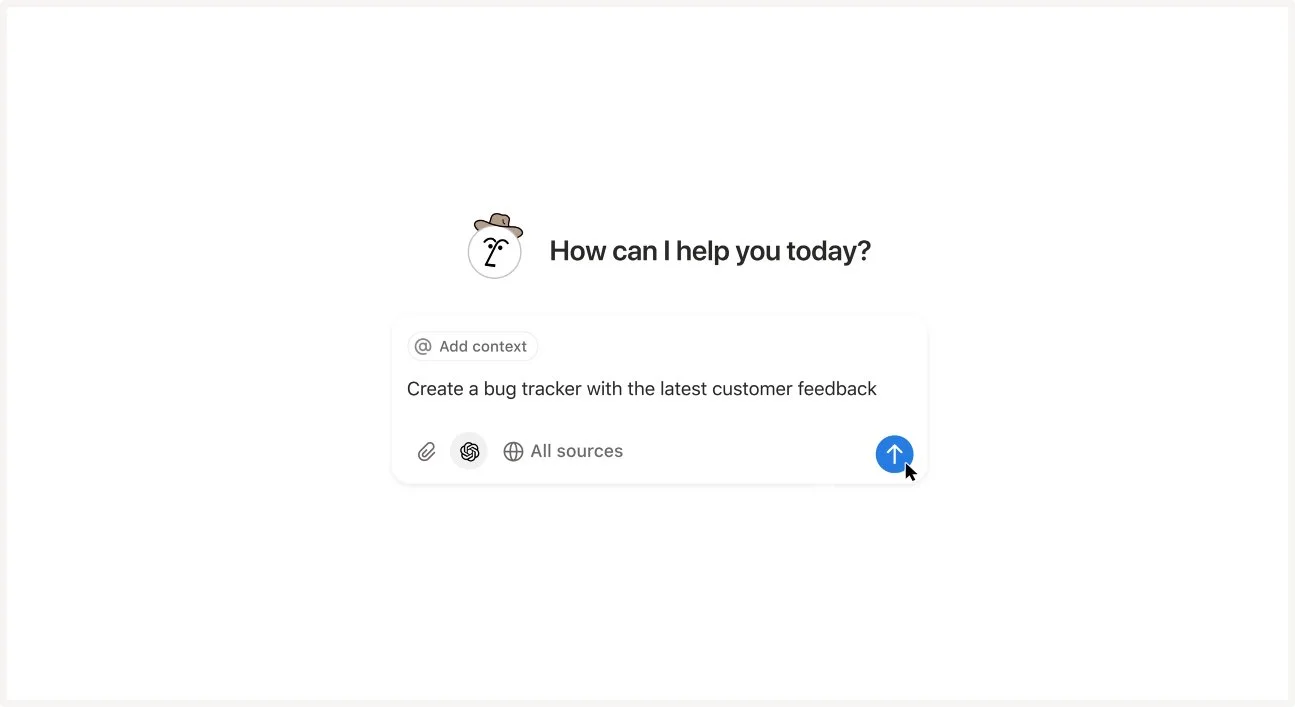
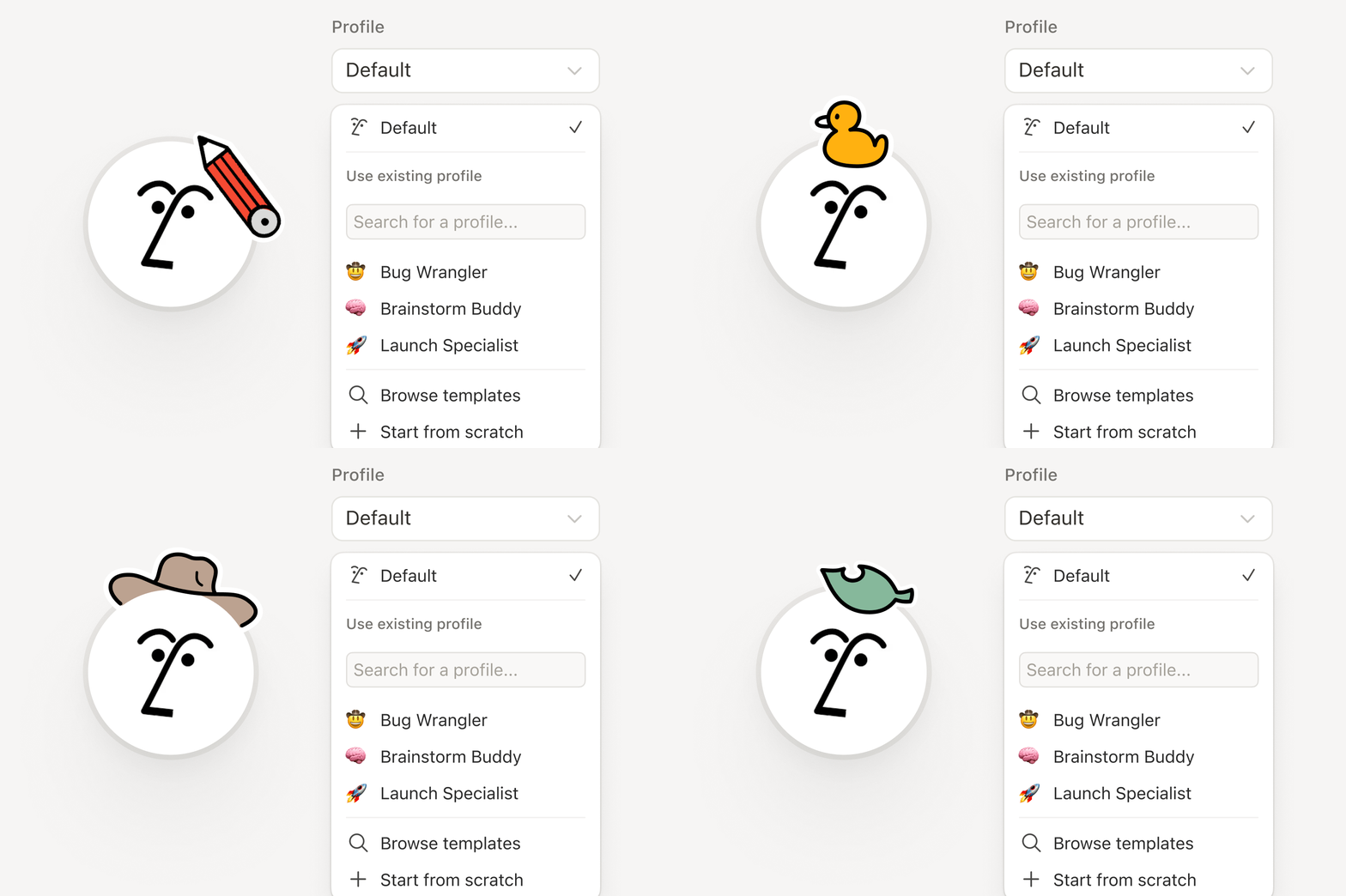
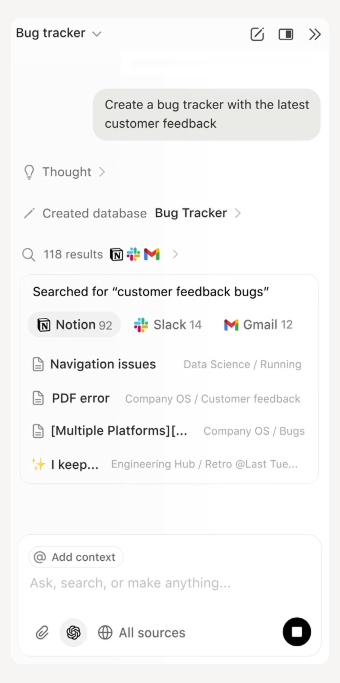
Notion is an all-in-one workspace that empowers individuals and teams to centralize their knowledge, documents, and projects through flexible databases.
[ The problem ]Context
This funnel analysis explores whether Notion’s agentic AI accelerates adoption, engagement, and retention during onboarding for new users.
Who the user is
John is an early-stage founder adopting Notion to organize his work, plans, and information as the complexity of his ideas and business grows. He is not a frequent-user yet, but he is motivated, time-limited, and proactively building a workflow to support real outcomes (projects, businesses, decisions).
What the AI feature is
Notion’s core strength lies in its flexible building blocks, (especially databases. With the introduction of Notion AI, as an agentic feature, the product promises faster-integrated creation, reduced cognitive load, and smarter collaborative workflows. The feature works by allowing users to test it mainly through a chat with limited free credits, then upgrading to the business plan.
Why this moment matters: (AI + core feature adoption)
Notion introduces the agentic AI (mostly surfaced as “AI chat”) before new users fully understand its core features logic—especially databases, which drive long-term adoption and retention. If AI accelerates onboarding by making workflows clearer and removing complexity early, it can reduce time-to-value and increase stickiness. If its agentic value is not clearly perceived during first interactions, or if the exploration is abruptly interrupted when hitting the paywall, AI risks being perceived as a nice-to-have instead of as a game changer during the first user interaction.
The Problem
Is the Notion AI perceived as a Value Multiplier at the right time, or is it perceived as a Feature Silo whose benefits are realized too late to drive adoption and convert users before the paywall?
[ highlights ]Funnel Stage Analysis Summary
| Funnel Stage | Core Observation | Risk Opportunity |
|---|---|---|
| Exposure | AI first-contact positioned as chat, not agent | Missed perception, slow value-signal |
| Activation | AI accelerates Database creation when value is clear, contextual and explicit. | Slow TTV / under-performing. |
| Engagement | Lack of repeated AI loops weaken habits. | Plateau risk, not aha! moment |
| Retention | Paywall triggers before value is internalized, invisible credits counts prevent intentional interaction. | Value never realized to full potential. Reduced upgrades to business plan. |
Actions recommended
EXPOSURE
Strategic Insight: Early and generic chat AI under-communicate the agentic integration and force, adding extra distraction during core logic onboarding.
Actions
Capture during account setup, user’s goals.
Replace generic chat with goal-driven AI agent communication
ACTIVATION
Strategic Insight: AI accelerates complex, sticky database creation by leading with integration, optimizing workflow. Users learn by example, multiplying free-time, and workflow performance.
Actions
Use context-aware prompts to hit "Aha!" faster.
Remove scarcity-driven tactics as hidden free credits, make them visible.
Offer bite-sized video-guidance to unlock the value of the feature inside the conversation.
ENGAGEMENT
Strategic Insight: Stickiness requires repeatable workflow integration.
Actions
Use context-aware prompts to hit "Aha!" faster.
Remove scarcity-driven tactics as hidden free credits, make them visible.
Offer bite-sized video-guidance to unlock the value of the feature inside the conversation.
RETENTION
Strategic Insight: Scarcity kills interest (hidden free credits). True value drives conversion.
Actions
Align paywall timing and messaging with demonstrated productivity gains in database-heavy workflows, from usage to data.
Implement for controlled group a # of days under a free trial, no free-credits based.
The Missed Opportunity
The primary risk is not the AI’s capability, but to under-communicate its contextual relevance during critical onboarding moments, causing new users to dismiss a powerful workflow agent as a nice-to-have AI feature.
Dive Into The Full Funnel Analysis
A powerful feature can lose momentum when its value is assumed rather than clearly communicated.
[ full analysis ]Stage 1: Exposure
Positioning mismatch at first contact
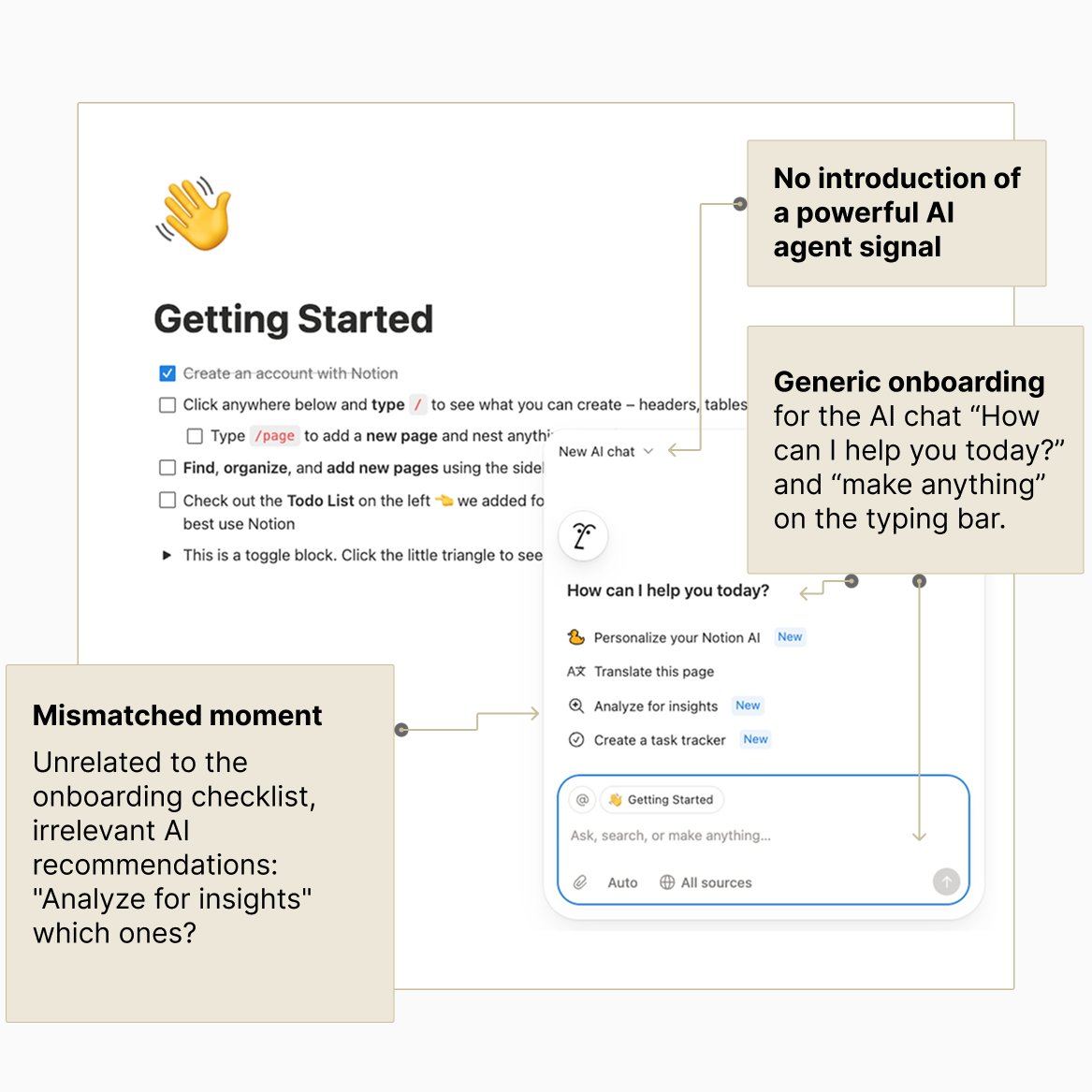
John logins for the first time
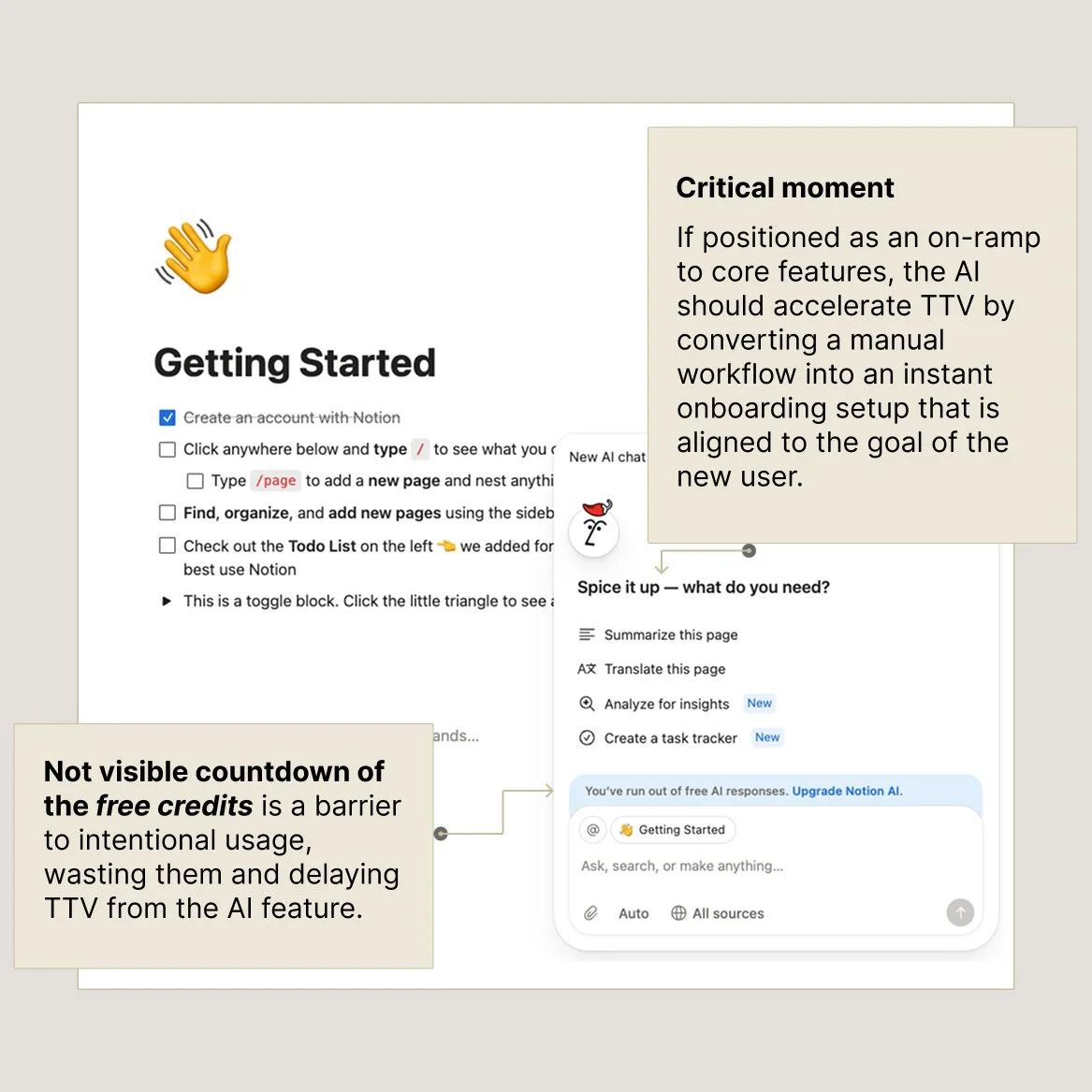
After opening his account, John reads “Getting Started” and a checklist. Immediately, an AI chat opens automatically and suggests actions like “how can i help you” or “create a task tracker”. Since the page is an onboarding checklist, the AI suggestions feels irrelevant. John closes the chat, without realizing this is not a generic chatbot, but an integrated AI agent.
Insight
At first interaction, Notion introduces AI as a generic chat rather than as an integrated agent that transforms pages, databases and workflows. The moment is mismatched, risking that users dismiss the AI as irrelevant before they have true intent or context, affecting activation.
Hypothesis
Without early signaling of agent-like capabilities, users may engage with AI as a surface-level novelty rather than an accelerator. This leads to low-intent exploration during onboarding, reducing curiosity and delaying discovery of core feature value. As a result, activation weakens downstream, increasing the likelihood that AI becomes a feature silo rather than a driver of database adoption.
What must be true if correct:
Time-to-first-database increases
Users exposed to AI early complete fewer onboarding checklist items
AI engagement prompts before database creation
Metrics:
% checklist completion
Time to first database
AI prompt interaction rate before checklist completion
Decision:
If validated: Amplify virtues of AI feature as a powerful agent during onboarding and push for a relevant first interaction by the user align with the onboarding checklist.
If invalidated: AI exposure does not harm core adoption, focus on the next stage to drive that TTV moment
Stage 2: Activation
The most critical moment
John is exploring
While testing Notion, John he inline prompt: “Press space for AI. This time, the AI responds directly to his work. He brainstorms product ideas, the chat structures them into tables, refines copy over and over. Suddenly, the paywall appears: “You’ve run out of free AI responses.”
John hadn’t realized credits were limited. He clicks to upgrade, sees the price, and decides to pause. Instead, he copies content from another AI tool and pastes it into Notion, breaking the loop that could have made Notion his primary workspace.
Insight
Notion AI is most effective when positioned as an on-ramp to core features, not as a generic AI chat. In the context of databases, AI significantly reduces time-to-value, replacing a traditionally manual workflow with an almost instant setup.
The lack of personalized task options and visibility regarding free credits create friction. This leads to wasted credits, delayed adoption, and an undervaluing of the feature, ultimately creating ambiguity at a critical activation point.
Hypothesis
If users are prompted to create a goal-aligned database instead of receiving the current generic AI prompt, plus transparency in free credits, then the time to an “aha moment” for core features such as database usage will decrease, leading to higher activation and stronger engagement. (An approach to know the user’s goal should be during opening the account)
Example: → “tell me more about this project you have in mind” → “Create a task tracker to organize this project” or “What you need to solve today”
What must be true if correct:
Conversion rate from AI prompt to database creation is higher with contextual prompts
Time to first database is reduced (Personalized group vs current journey)
AI activations correlate with faster upgrade to next paid plan after paywall
Metrics:
Database Creation Rate (personalized vs generic prompts)
Time-to-First-Database-Usage (TTV)
# of days engagement of AI-activated users
Time to upgrade after paywall for the AI personalized group vs generic
Decision:
If validated: Prioritize contextual, problem-solving, goal, explicit AI prompts for core feature activation, aligned with user’s goal. The goal should be known during opening the account. Make free credits countdown visible.
If invalidated: Test alternative AI “key moments” such as document analysis, structuring page content.
Stage 3: Engagement
Workflow formation risk
John actions
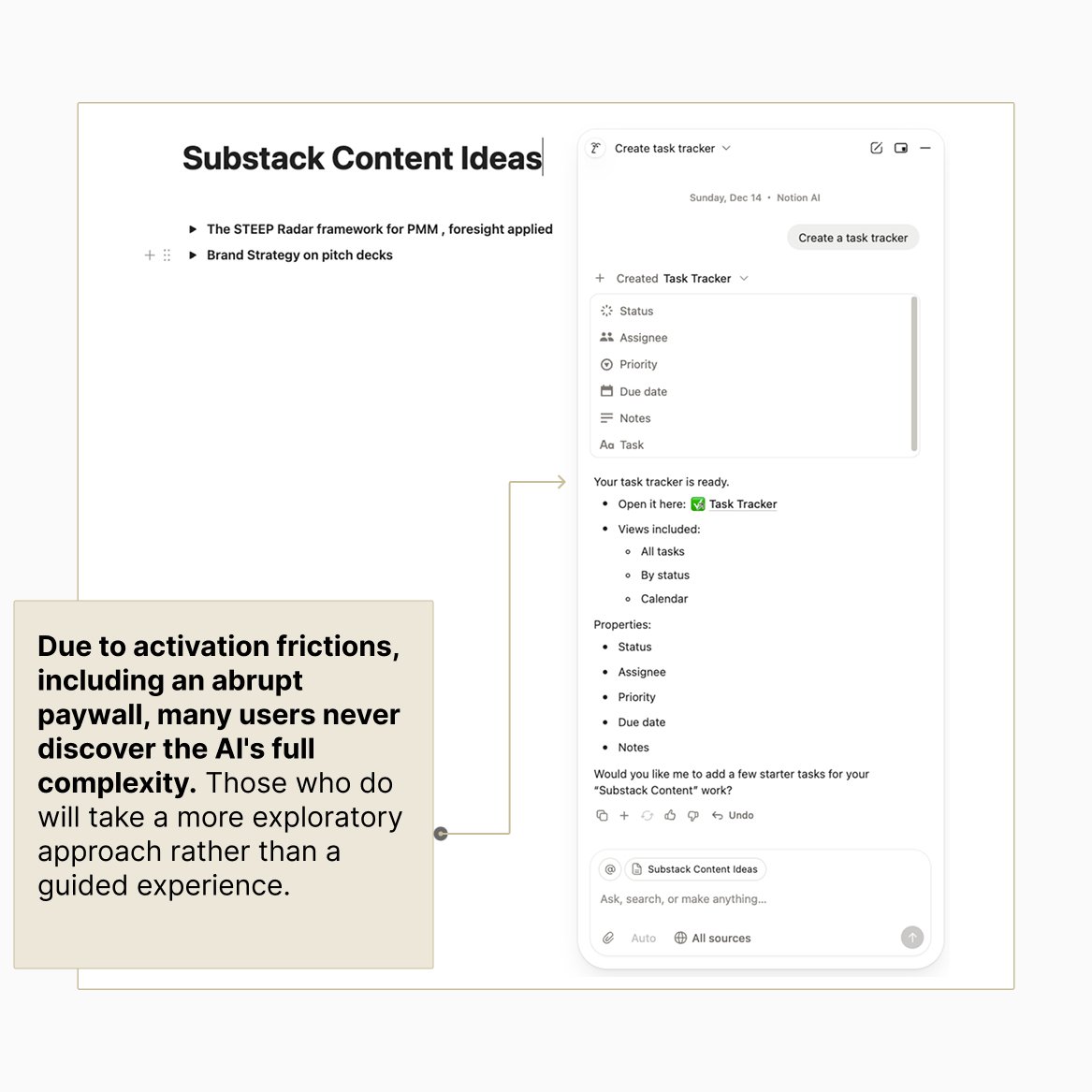
In the following weeks, John uses Notion intermittently. Databases exist, but they are not yet a continuous workflow he uses. He keeps using his previous setup, going back to word documents, and using Chat GPT, he already pays for it. Notion remains useful, as a more organized version of all rough information but not indispensable, the engagement has plateaued.
Insight
Engagement is driven not by occasional AI usage, but by workflow integration. Notion becomes sticky when users repeatedly return to it not just to store information, but to actively work through it with speed and reduced friction. At this stage, AI risks being perceived as “nice to have” rather than game changer for users goal: the paywall limits continued interaction.
Hypothesis
If Notion AI proactively supports recurring, high-value workflows (planning, synthesis, system updates) through contextual prompts and follow-ups, plus it renew periodically the free credits available or a trial version, then users will integrate AI into their daily operating system.
What must be true if correct:
Users receiving contextual AI follow-ups engage more frequently with databases
AI usage first interactions shift from one-off tasks (translation, summaries) to complex, repeatable workflows (remaining credits are visible)
Engagement increases when AI suggestions are framed contextual with next steps for specific outcomes.
Upgrade % after trial
Metrics:
AI prompt usage: system-suggested vs user-initiated
Frequency of high-value prompts vs low-value prompts
Weekly AI usage depth within database workflows vs hidden credits group
Session continuation after AI interaction
Decision:
If validated: Make free credits visible, and design more personalized AI interactions around within workflows.
If invalidated: Refocus AI engagement on fewer, clearly repeatable use cases with higher perceived ROI, test.
Stage 4: Retention
Monetized the value delivered
John’s new workflow
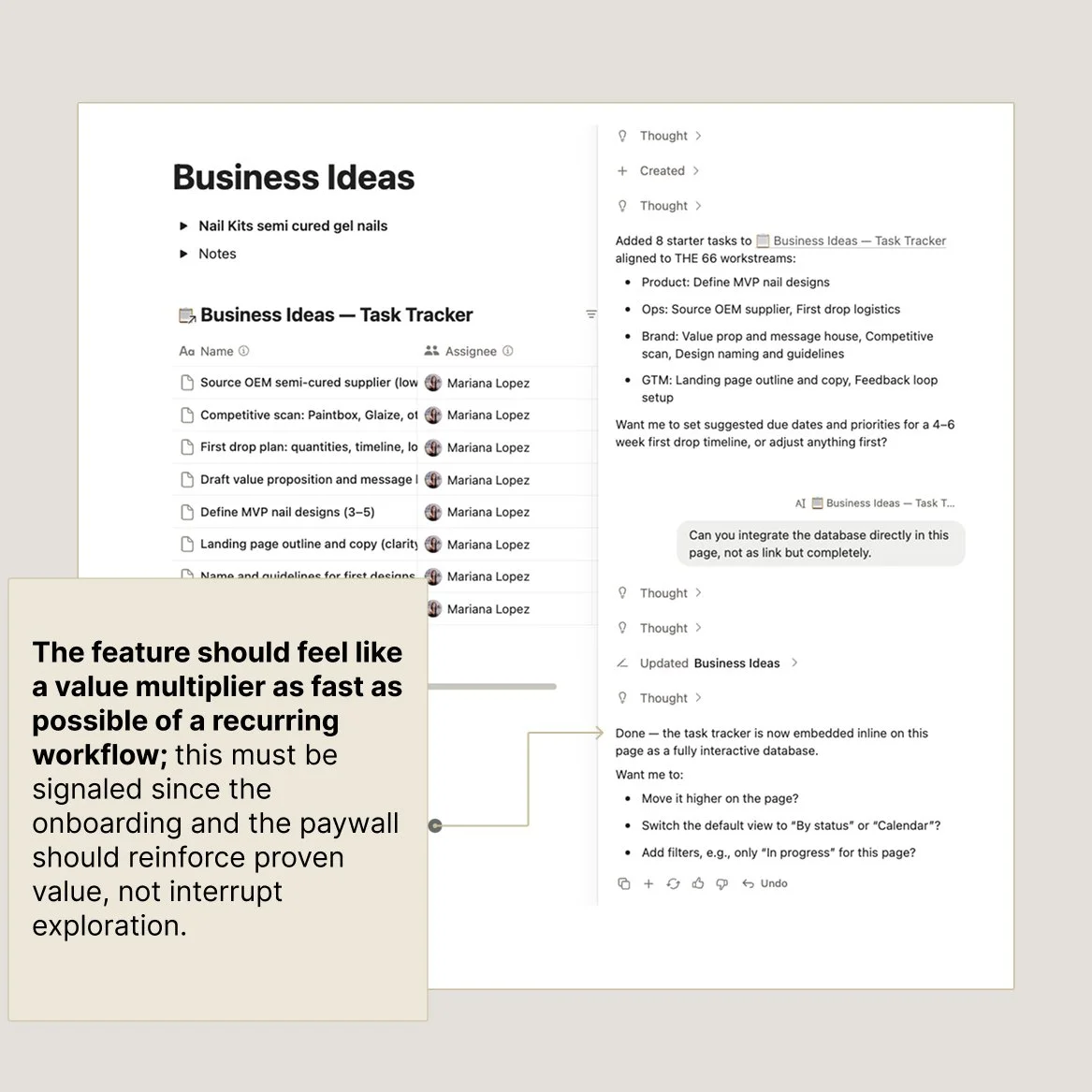
Later, John receives an email offering 15 days of unlimited Notion AI. He revisits his databases. AI helps refine structures, surface insights, and improve organization without manual effort. He begins learning Notion’s power by example, through use, not documentation.
The original promise finally clicks: “a team of 7 feels like 70.” By the end of the trial, upgrading feels justified, he gets the business plan.
Insight
Notion AI drives retention when perceived as a value multiplier for recurring, high-impact tasks. Not-visible credit depletion creates a hidden friction, not urgency, especially if users have not yet connected AI usage to long-term productivity gains.
The paywall should reinforce proven value, not interrupt exploration.
Hypothesis
If the paywall is triggered after users experience a successful, high-impact AI-assisted outcome (e.g., building or improving a database connected to current work), rather than at simple credit limitation, then upgrade conversion will increase.
What must be true if correct:
Users exposed to value-affirming paywalls convert at higher rates
Database-heavy users with AI assistance retain more strongly at 30 days
AI upgrades correlate with recurring workflow usage, not exploratory usage
Metrics:
Upgrade conversion rate by paywall timing
Retention of database-only vs database + AI users
+30 day retention post-paywall
Decision:
If validated: Reframe monetization around productivity amplification, not scarcity.
If invalidated: Reevaluate whether AI’s perceived value is strong enough at current exposure points
Recommendation for each funnel stage
Notion can drive product adoption faster among new users by making AI feel like a relevant part of the first onboarding journey, rather than a chat that pops up. Additionally, being transparent about the limited "free credit" system, Notion creates a value ramp that lets new users speed up the TTV, signaling a one-stop workflow without having to learn every core feature first.
Exposure
Strategic Insight: Early AI exposure risks being misinterpreted as a generic AI chat, causing new users to ignore its role as a core workflow accelerator before understanding Notion’s logic workflow model.
Key actions
Reframe AI, as promised, not a chat, but an agent. Replace generic prompts with page-aware, goal-based nudges that explicitly connects the goal of the user, goal question added during account set up.
Activation
Strategic Insight: AI delivers its strongest value when positioned as the fastest path to core feature adoption, particularly databases, by translating intent into structure.
Key actions
Make AI the default on-ramp to database creation through personalized, goal-aligned prompts This requires transparency on remaining credits for intentional usage, in order to reduce time-to-first-value and accelerate the “aha” moment. Before paywall.
Engagement
Strategic Insight: Long-term engagement depends on whether AI becomes embedded in recurring workflows rather than remaining a one-off productivity aid.
Key actions
Reinforce AI as part of repeatable workflows via contextual follow-ups, suggested high-value prompts, and Home-level nudges tied to ongoing goals.
Retention
Strategic Insight: Users convert when AI is perceived as a value multiplier for complex, recurring work, not when framed as a limited, consumable credit.
Key actions
Align paywall timing and messaging with demonstrated productivity gains in database-heavy workflows, reinforcing AI as a long-term efficiency investment rather than a usage constraint.
This analysis is based on observed product onboarding behavior and public positioning, not internal data.